
NuAlphaCELL
Electrodeposition cell for the preparation of high resolution alpha spectrometry samples
Alpha spectrometry results depend on the quality of the measured sample. NuAlphaCell transfers radionuclides from solution onto a stainless steel planchet by electrodeposition under controlled conditions: geometry, current, deposition time and electrolyte stirring. During process verification, nearly quantitative deposition was achieved in the pH range of 1.6 to 2.2.
Key benefits
- Reproducible deposition conditions: constant-current mode (typically 1 A) and adjustable anode–cathode distance with an indicator (typically 10 mm).
- Homogeneous electrolyte: rotating PtIr 90:10 spiral anode at 0 to 200 rpm and a cassette with eight NdFeB magnets.
- Verified deposition yield: nearly quantitative deposition at pH 1.6 to 2.2; recommended working range pH 1.8 to 2.0.
- Reduced risk of cross-contamination: replaceable 20 ml HDPE deposition vials and Ø 25 × 0.5 mm planchets, 10 of each supplied.
- Easy decontamination: removable parts made of PEEK, PVDF and stainless steel, integrated drip tray.
- No control electronics or software: powered by the supplied two-channel laboratory power supply, 0–30 V DC / 0–3 A, safety extra-low voltage (SELV).
- Compact for fume hood use: dimensions approx. 140 × 180 × 300 mm, weight approx. 4.3 kg.
System overview
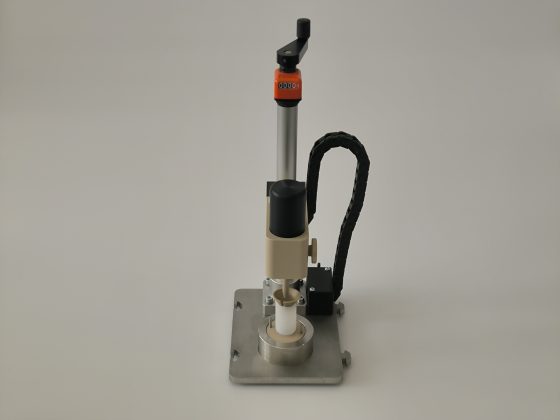
The assembly comprises the cell body with a vertical slide and electrode distance indicator, a base with a planchet seat, a centre ring holding the deposition vial, a condensation funnel and a motor-driven rotating anode. The stainless steel planchet forms the cathode, on whose surface the radionuclide is deposited electrochemically from the electrolyte.
Channel 1 of the laboratory power supply drives the electrodeposition in constant-current mode; channel 2 powers the 24 V DC anode motor, whose speed is set by voltage. An oxalate- and sulphate-based electrolyte with added DTPA at a pH of about 1.9 is used as standard. The device is designed for operation in a laboratory fume hood or a dry indoor environment.
Typical applications
- Radiochemical laboratories prepare measurement samples from solution on a stainless steel planchet for the determination of alpha emitters by alpha spectrometry.
- Laboratories prepare standards for low-energy gamma spectrometry.
- Facilities in the nuclear industry, environmental monitoring and radiation protection ensure repeatable sample preparation for alpha spectrometry.
Main specifications
| Parameter | Value | Unit |
| Active deposition | approx. 200 | mm² |
| Planchet (cathode) | stainless steel AISI 304/316, Ø 25 × 0.5 | mm |
| Anode | rotating spiral, PtIr 90:10 | – |
| Anode speed range | 0 to 200 | rpm |
| Deposition vial | HDPE, 20 ml, Ø 26.5 × 60 | mm |
| Electrodeposition current (constant current) | typically 1 | A |
| Voltage across the electrodes | 8 to 20 | V |
| Deposition time | typically 90 to 120 | min |
| Electrolyte volume | approx. 4.5 | ml |
| Electrolyte pH (working range) | 1.8 to 2.0 | – |
| Power supply | two-channel laboratory power supply 0–30 V / 0–3 A; motor 24 V (SELV), 110 mA | V DC |
| Dimensions (w × d × h) | approx. 140 × 180 × 300 | mm |
| Weight | approx. 4.3 | kg |
| Operating temperature | −10 to +45 | °C |
| Relative humidity | 20 to 85 | % |
| Ingress protection | not specified (open laboratory device) | – |
| EU conformity | 2006/42/EC, 2014/30/EU | – |
-
200 mm2
Active area
-
0
Cross contamination
-
8 pcs
Cylindriccal magnets
Need help?
If you have an enquiry about any of our products or services, please do not hesitate to give us your feedback or suggestions.